
Srikanth Kondapalli on what to expect from the seventh BRICS summit meeting to be held in Russia in July.

'The military aim in a future conflict, if it can't be avoided, should be to cause maximum damage to the adversary's war waging capability and capture limited amount of territory as a bargaining counter,' says Brigadier Gurmeet Kanwal (retd).

Four major political takeaways from Narendra Modi's much-anticipated trip to China

'Clearly, from the Indian viewpoint, the US retrenchment from Asia cannot be happening as good news.' 'The abandonment of the US' pivot to Asia exposes the US-Indian partnership to be a mere transactional relationship,' says Ambassador M K Bhadrakumar

'A participant in many rounds of the border talks with China once told me that China seemed not interested in resolving the border issue as it wanted to keep it as a ready excuse to intervene in the sub-continent,' says Colonel (retd) Anil A Athale.

'The public has unfair expectations from Mrs Swaraj who is in Islamabad primarily for the Heart of Asia Conference. To restore India's position among stakeholders on Afghanistan is a fair one but to expect her to do more on the Indo-Pak front without requisite preparatory work is unrealistic.'

'One lesson to emerge out of the Modi-Putin summit is that India can be more self-confident that it possesses inherent strengths to leverage its interlocutors to influence Pakistani policies,' says Ambassador M K Bhadrakumar.

'It will make good sense for military men on that side of the table to be confronted by our own.'

Sheela Bhatt, who is travelling with Prime Minister Manmohan Singh on his two-nation visit, analyses the outcome of crucial talks between the PM and his Chinese counterpart in Beijing.

'During his visit to Vietnam on September 3 -- the first visit by an Indian prime minister in 15 years -- Modi will notice the widespread anti-China sentiment in that country.'

The earthquake with epicentre at Lamjung, around 80 kilometres northwest of Kathmandu, and had its impact inseveral cities in Bihar and West Bengal and eastern India. Anumber of aftershocks were felt for a long time after the quake.

'The BRICS anthem has to necessarily be an anthem of Vedic times -- Walk together, Dream together, Achieve together.' 'And who knows it better than Modi?' says Tarun Vijay.

Despite vast differences in the way the media operates in the two countries, an India-China media forum will go a long way in improving understanding between the two countries, says Srikanth Kondapalli.

The Doha Round of talks of the World Trade Organisation (WTO) faces a new challenge and if some statements emanating after the General Council meeting on July 25 at Geneva are to be taken at face value, this could derail the process of trade liberalisation through a multilateral route for some time.

For a rising country like China with its sights set on global and regional power, any coming together of the US and India is the worst case scenario. Hence, China is concerned with the emerging equations between New Delhi and Washington, says Srikanth Kondapalli.

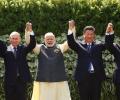
Narendra Modi's success at the BRICS summit is the best Diwali gift for India's diplomacy and marks her ascendancy to global leadership, says Tarun Vijay.

Nevertheless, border dispute will feature prominently on Modi's agenda but the matter won't be discussed at length. Nayanima Basu reports
China wants a code of conduct for troops on the India-China border areas. While the Indian side has reacted cautiously, it is not clear what effective additional protocols that the current proposed code will bring forth to usher stability in the border areas, says Srikanth Kondapalli.

Any additional effort to assuage the growing worldwide hunger for infrastructure funding is more than welcome, says Barun Roy.

In spite of irritants and hiccups in the relationship, a few deliverables are expected of the prime minister's visit to China, says Rup Narayan Das.

Inflation is down and there's every chance that crude prices will be subdued through the next year.
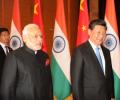
While the two sides' objectives may appear to differ, it is clear that both India and China are emphasising on the common minimum possible areas of cooperation between them, says Srikanth Kondapalli.

Modi's arrival has changed the optics of the visit. There is a different demonstration of the confidence level in the Indian leadership, but not much has changed beyond that, reports Sheela Bhatt/Rediff.com.

'How can a State, which claims to be a responsible power, unilaterally grab a "disputed" area to build a road on it?' asks Claude Arpi.

One thing Beijing must understand is that India is not obsessed with being a threat to China but only wants a rightful place for itself in the world, says Sanjeev Nayyar.

India hopes to bridge gap with US to buffer against a Paris agreement that restricts country's developmental space.

'He is the man,' US President Barack Obama had said at a G-20 gathering, enhancing Lula's stature. Six years later, has Brazil's impressive economic growth turned to sand? Will a President, who enjoyed an 80 per cent approval rate in his country, be arrested? Ambassador B S Prakash, India's former envoy to Brazil, explains what has gone wrong in one of India's BRICS partner nations.
Public interest centres on whether the two leaders might make headway in resolving the Sino-Indian boundary dispute.

'Until India fully absorbs the fundamentals of international relations, it will continue to get evil for good,' says Brahma Chellaney.

The India that needs strategic alliances, defence cooperation and engaging meaningfully with neighbouring countries is quietly moving ahead with confidence, says Tarun Vijay
